

Skip to content
    Diana Newell

    Help your team solve problems without you

    Practise coaching instead of solving: ask before you advise, and leave the next step with the other person.

    Watch: the Coaching Skills programme

    Moments covered

    Development

    Coaching not solving

    27% of 11,359 real cases · Report 01, v0.2

    Who it's for.

    • People leaders and managers

      Building a team of independent thinkers, so their impact scales beyond their own diary.

    • Internal mentors and coaches

      People who want a structured framework for their formal and informal coaching sessions.

    • For you

      Practise the conversations in this pathway and receive feedback on what you actually said.

    • For your organisation

      Build evidence around the conversations your people need to handle, with aggregate-only reporting.

    What the programme teaches.

    Most managers spend much of their time solving other people's problems. Diana Newell's programme teaches the shift from telling to asking, so the other person leaves owning the next step.

    • Coach without taking the problem back

      Practise the shift from giving answers to asking questions, so the other person leaves owning the next step.

    • Ask before you advise

      Rehearse open questions and listening in a practice conversation, then see which questions you actually asked.

    • Make honest answers easier

      Build the questioning and listening habits that make it easier for people to tell you what is really going on.

    The core focus

    • The ELECTRIC model

      An eight-step coaching structure, from setting targets and exploring options to securing commitment and reviewing progress.

    • The I-to-I mindset

      Moving your focus from your own expertise to the other person's potential, so you stay supportive and non-directive.

    • Psychological safety

      Creating the conditions in which people feel able to take risks, learn and try again.

    Key techniques

    Three habits that hand the thinking back to the other person.

    • The 3:1 questioning ratio

      Replacing leading questions with open ones, so the other person does the thinking.

    • Observation vs evaluation

      Feedback that describes behaviour, which invites reflection rather than defensiveness.

    • The monkey on the back

      Spotting when a problem has moved onto your plate, and using coaching to hand ownership back.

    Programme structure

    Framework: ELECTRIC

    1. Sessions

    2. Attempts

    3. Moments

    GuruNow results after a Giving Feedback simulation: the path to Verified, twelve skills signals marked new, in hand, fading or not yet, and three things to try next time
    After every simulation challenge: each skills signal you showed or missed, with what you said behind it.
    On-demand coaching

    Ask your guru before it counts.

    On-demand coaching is a short spoken session with Diana Newell, whenever you need it, at 3pm or 3am. Use it to prepare for the real conversation.

    People use it for

    • Preparing to give a performance review
    • Finding the words for difficult feedback
    • Refining your approach just before a critical one-to-one

    Evaluate the real thing.

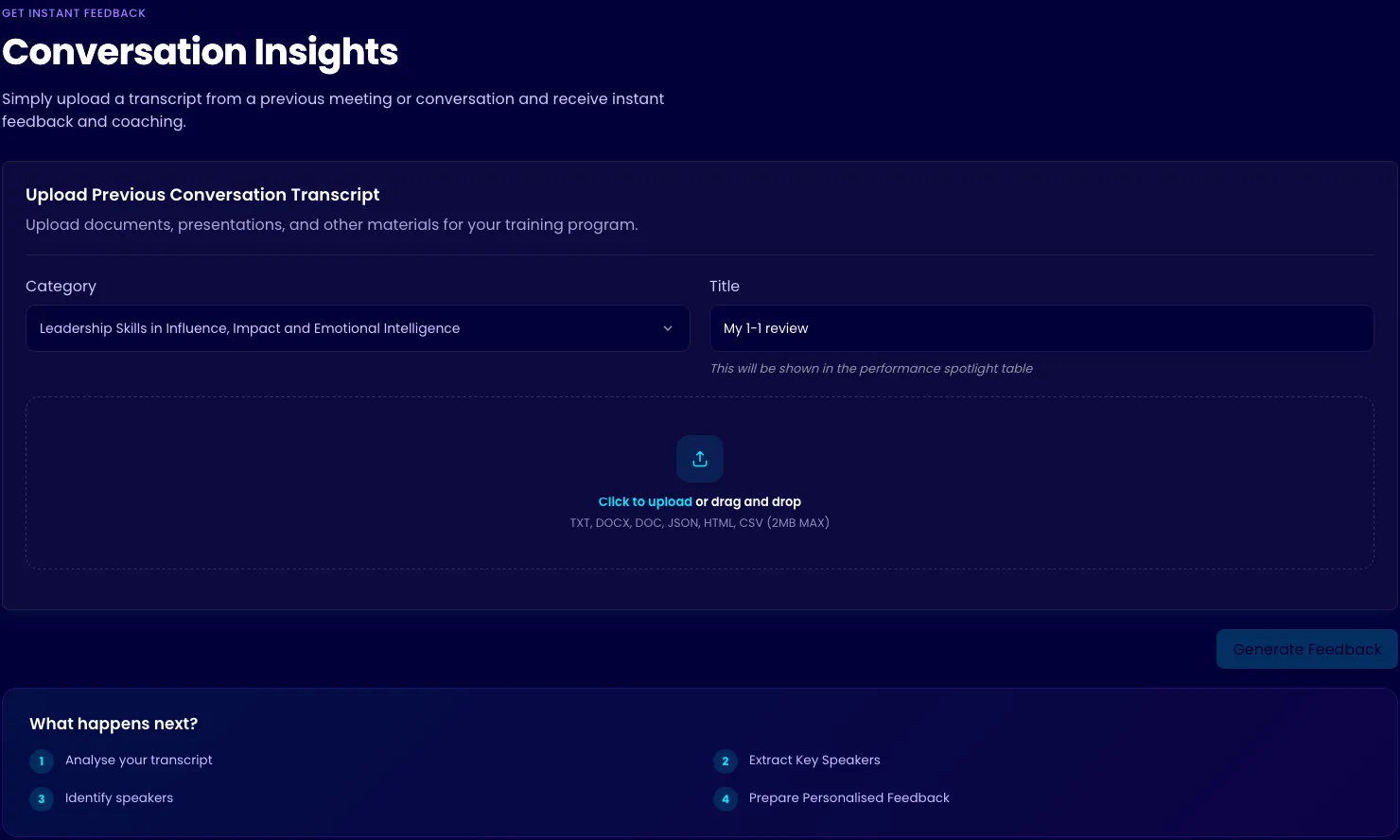
    Conversation Insights applies the same observable-marker approach to a real conversation, with consent.

    The GuruNow Conversation Insights screen: choose a category, name the conversation and upload its transcript for feedback
    Your guru

    Diana Newell

    Diana Newell is a coach and team coach. She works with strategic leaders, their teams and their organisations, helping them make freer choices and act with a greater sense of agency.

    An engineer by background, she worked across logistics, vacuum engineering and chemicals at The BOC Group, leading organisations in the US and Europe as an executive board member and VP. She later ran the European part of the consultancy Blessing-White, set up her own coaching practice, Jericho Partners, in 2000, and joined the OCM as a director and board member in 2011.

    Diana Newell, programme guru

    Questions

    Participants practise the workplace conversations mapped to this programme.

    Feedback is tied to observable behavioural markers in the conversation transcript.

    Managers see engagement; capability reporting is aggregate-only above an agreed minimum group size.

    Your framework can remain the standard and be mapped to the moments where capability must become observable.

    How can this help you now?

    For you

    Learn the skill. Practise that tough conversation privately, now.

    • Try a simulation free
    • See the sentence behind every result

    Practise, Measurement, Feedback, Confidence. It's in your grasp.

    Try it now!
    For your organisation

    Honest data, because nobody performs for an audience

    • Find which Moments your leaders actually struggle with
    • Evidence mapped to your competency framework
    • Aggregate-only reporting

    Psychological safety leads to better outcomes

    Book a Team Demo